Dressing the Woman You're Becoming Without Erasing the One You've Been
The Problem With 'New Chapter, New Me'
There's a version of reinvention that looks really good on a vision board. You purge everything, go minimalist or maximalist or whatever the aesthetic du jour is, and emerge looking like you just got back from a life-changing trip to a European city you can barely afford. It's dramatic. It's satisfying in theory.
 Photo: European city, via coloringhub.com
And it almost never sticks.
Because here's what nobody tells you when you're standing in your closet at 11pm Googling 'how to build a capsule wardrobe': your style isn't just about clothes. It's a running autobiography. Every piece you've held onto has a reason — even if that reason is 'I paid too much for this and I'm not ready to admit it was a mistake.' The way you dress is one of the most intimate expressions of how you see yourself, and when your life shifts, your wardrobe feels it first.
But the answer isn't always a bonfire.
What a Soft Pivot Actually Looks Like
A soft pivot is exactly what it sounds like — a gradual, intentional shift that honors where you've been while making space for where you're going. In style terms, it means you're not discarding your whole identity. You're editing it.
Think about it like a playlist. You don't delete every song you've ever loved just because your taste has evolved. You add new tracks, maybe retire a few that don't hit the same way anymore, and suddenly the whole thing has a different energy without feeling foreign to you.
That's the goal here. Continuity with intention.
Maybe you've spent the last several years in a certain mode — say, corporate-creative, or young-and-casual — and something has shifted. A new job, a move, a relationship, a birthday that made you think harder than you expected. Whatever it is, you know your current wardrobe is speaking a language that no longer quite fits your mouth. But you're not sure what the new language is yet, and that uncertainty can make even the idea of shopping feel overwhelming.
So you do nothing. Or you buy something impulsive that doesn't integrate with anything else you own. Neither works.
Start With What You Actually Reach For
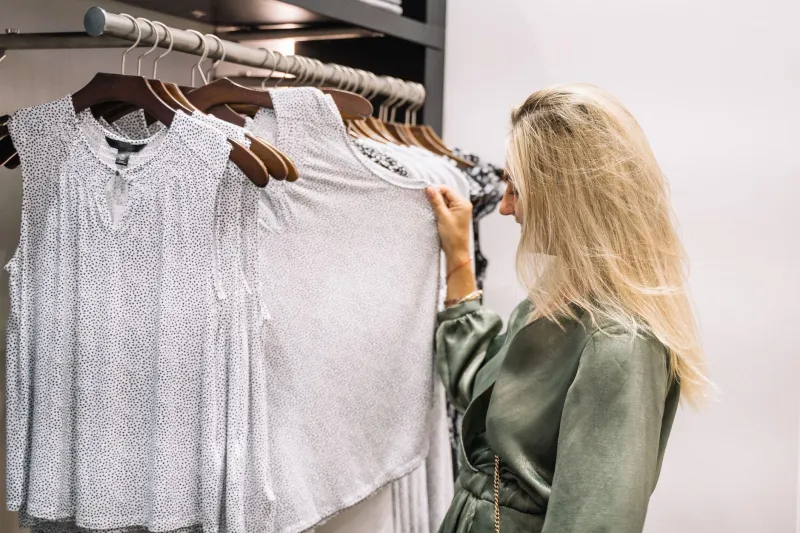
Before you buy a single thing, do the honest audit. Not the aspirational one where you hold up a blazer and imagine the life you'd live in it — the real one. What do you actually put on your body when you have somewhere to be and you want to feel like yourself?
Those pieces are your anchors. They're telling you something true about your taste, your body, your comfort level, and your actual life — not the life you're performing.
For a lot of women, this exercise is clarifying in a way that's almost uncomfortable. You realize the 'real you' has been quietly consistent all along, and the stuff that feels off is the stuff you bought trying to be someone else — whether that was someone more professional, more trendy, more put-together, or more whatever you thought you were supposed to be at the time.
Your anchors don't have to stay forever. But they're your starting point.
Layering In, Not Throwing Out
Here's the actual mechanics of a soft pivot: you introduce new elements slowly, and you let them live alongside what you already have before you decide what stays.
Maybe you've always been a jeans-and-a-great-top person, and you want to start incorporating something softer, more intentional — a linen midi skirt, a structured blazer in a color you'd never tried before, a pair of loafers that feel more grown. You don't throw out the jeans. You start pairing the new pieces with what you already own and see what happens.
This is how real style evolution works. It's less 'makeover' and more 'conversation.' The new pieces start talking to the old ones, and over time, you can see which relationships are working and which aren't. What integrates naturally is probably meant to stay. What always feels like a costume probably isn't yours.
Color is one of the easiest entry points for this. If your closet is full of neutrals and you're curious about something more expressive, you don't have to go full maximalist overnight. Start with one piece in a color that genuinely excites you — not one that's trending, one that makes you feel something when you look at it. Wear it with what you already own. See how it feels.
The Emotional Side Nobody Talks About
Style transitions during life transitions are emotional, and it's okay to name that. Getting dressed is never just about clothes — it's about how you want to show up, who you're signaling yourself to be, and sometimes, who you're grieving.
If you're coming out of a long relationship, or a job that consumed your identity, or a version of yourself you worked really hard to build, your wardrobe is going to carry some of that weight. There might be pieces you can't get rid of yet even though they no longer fit your life. There might be pieces you want to hold onto for reasons that have nothing to do with how they look.
That's fine. Give yourself permission to move at your own pace. A soft pivot isn't a deadline.
What it is, though, is a choice. A conscious one. You're deciding to let your outside start reflecting your inside — not all at once, not perfectly, but incrementally and honestly.
Practical Places to Start
If you're not sure where to begin, here are a few low-stakes ways to start the conversation between who you've been and who you're becoming:
Try one new silhouette. If you've always worn fitted everything, try something oversized. If you've lived in flowy pieces, try something more structured. You don't have to commit — you're just gathering information about yourself.
Invest in one quality piece that feels like the next version of you. Not a whole wardrobe, just one thing. A bag, a coat, a pair of shoes. Something you'd have to grow into slightly but that doesn't feel completely foreign.
Edit, don't purge. Instead of a total cleanout, remove just the pieces that actively make you feel bad when you wear them. Not the ones you're unsure about — the ones you know. That's enough for now.
Notice what you're drawn to, even if you're not ready to buy it. Save images, walk through stores, pay attention to what catches your eye consistently. You're building a vocabulary before you start speaking.
The Goal Isn't a New You
I want to say this clearly, because I think we get sold a version of reinvention that's really about erasure: the goal of evolving your style is not to become unrecognizable. It's to become more fully yourself.
The best style evolutions I've ever witnessed — on real women, not magazine spreads — look like someone finally stopped apologizing for who they are and started dressing like they meant it. Not a costume. Not a character. Just a clearer, more honest version of the person who was always there.
That's what a soft pivot is really about. Not burning it down. Building on it — carefully, intentionally, and on your own timeline.