When Your Closet Starts Telling the Truth Before You Do
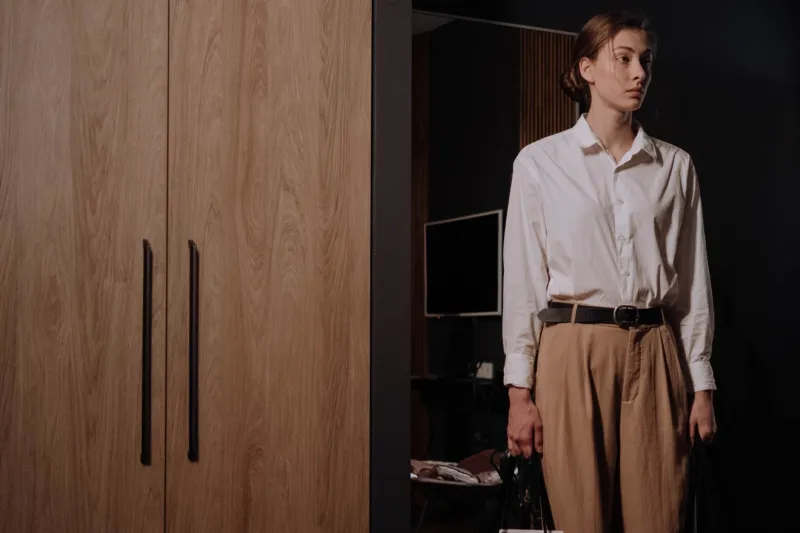
There comes a point — usually somewhere in your late thirties or forties — when getting dressed stops feeling automatic and starts feeling like a negotiation. The clothes are all still there. Same hangers, same shelves, same Sunday-night ritual of picking out the week. So why does nothing fit the person standing in front of the mirror?
Not in the size sense. In the truth sense.
This is the wardrobe audit nobody puts on your calendar. No one warns you that one day you'll open your closet and feel a quiet, unsettling distance from everything inside it — like walking into a room you used to love but can't quite remember why. The clothes haven't changed. You have. And your closet, bless it, is the first place that refuses to pretend otherwise.
The Clothes You Stop Reaching For Are Trying to Tell You Something
Most of us treat the items we avoid as a wardrobe problem. Too tight. Wrong season. Needs tailoring. We make practical excuses because the real explanation feels harder to say out loud: that version of me doesn't live here anymore.
That blazer you wore to every important meeting for three years? The one that made you feel sharp and capable and like you had something to prove? Maybe you don't need to prove that particular thing anymore. Maybe the ambition it represented has shifted into something quieter, more internal — and the blazer just doesn't know that yet.
The flirty going-out tops from your early thirties. The corporate-casual separates from a job that slowly hollowed you out. The "I'm trying to fit in here" outfits from a chapter you're finally, gratefully, closing. They're all still hanging there. Faithful. A little heartbreaking.
When you stop reaching for something consistently, that's not laziness. That's information.
Why a Wardrobe Audit at This Stage Is Different
The standard advice — pull everything out, make three piles, donate what doesn't spark joy — is fine for a spring clean. It's not designed for an identity reckoning.
Because what you're actually sorting through isn't fabric. It's assumptions. Assumptions about who you were supposed to become by now. About what dressing "appropriately" means for a woman your age. About whether you're allowed to be more interesting, more relaxed, more bold, more soft than the wardrobe you've accumulated suggests.
America has a complicated relationship with women and aging and style. There's an invisible script that says somewhere around midlife you should be settling into a look — classic, refined, predictable. Invest in quality basics. Neutrals. The kind of wardrobe that communicates I have arrived without specifying where, exactly, you've arrived to.
But what if where you're going doesn't look like that? What if the woman emerging from this particular season of your life is stranger, softer, bolder, or simply more herself than the carefully curated capsule wardrobe of your imagination?
That's the audit worth doing. Not just does this fit? but does this fit who I'm actually becoming?
A Different Kind of Inventory
Before you start pulling things off hangers, try this first: spend a week noticing what you reach for without thinking. Not what you should wear. What you actually grab when you're running late or tired or just want to feel like yourself.
That pile — the worn-in jeans, the specific cardigan, the dress that gets compliments every single time — is your real closet. Everything else is a museum of past selves and future aspirations that may or may not still apply.
Once you know what your real closet is, you can look at the rest with a little more honesty:
The aspirational items. The things you bought for a life you were planning to live. The structured linen trousers for the sophisticated weekends. The heels for the dinners you kept meaning to book. Ask yourself: is that life still coming, or did you quietly decide against it? No judgment either way. But holding onto the costume of a life you've outgrown is its own kind of weight.
The obligation pieces. The things you wear because you think you should. Because they were expensive. Because someone gave them to you. Because they're practical and responsible and that's what you're supposed to value now. Gratitude is real, but guilt is a terrible stylist.
The identity relics. These are the trickiest. The pieces that represent a version of you that mattered — the hustle-era power suit, the cool-girl vintage leather jacket, the soft feminine dresses from a more romantic chapter. You don't have to throw them out. But you do have to decide whether you're keeping them because they still reflect something true, or because letting them go feels like letting her go. Sometimes the answer is both. That's okay too.
Dressing Forward Without Performing Someone Else's Version of You
Here's the part where most style advice goes sideways: it tells you to replace what you've cleared out with a curated, intentional, aspirational wardrobe that reflects the woman you want to become. There's a mood board. There's a color palette. There's a Pinterest board called something like "Her" with 400 pins of outfits worn by women who are not you, in cities you don't live in, for lives that are adjacent to but not actually yours.
Don't do that.
Instead, buy one thing that feels true right now. Wear it. See how it moves through your actual life — your actual mornings, your actual job, your actual errands, the dinner you're actually going to on Saturday. If it holds up, it belongs. If it sits in the closet waiting to be worn by the more exciting version of you, it doesn't.
Dressing for the woman you're becoming is not a project you complete. It's a practice you return to. Some seasons you'll be more experimental. Some seasons you'll need comfort and reliability more than self-expression. Both are valid. Neither is a failure.
The goal isn't a perfect wardrobe. The goal is a wardrobe that doesn't feel like a lie when you open it in the morning.
The Honesty Is the Point
What makes this particular wardrobe moment — the midlife one, the identity-shift one — so disorienting is that it's rarely about the clothes at all. The clothes are just the most visible, tangible evidence of something that's been shifting quietly beneath the surface for a while.
You've been changing. Your priorities have been rearranging themselves. The things that used to matter enormously have softened, and some things you barely thought about have moved to the center. Your closet didn't get that memo until now.
So give yourself some grace. This kind of audit takes longer than a weekend. It asks more of you than a donation bag and a few new basics. It asks you to be honest about who you've been, curious about who you're becoming, and patient with the space in between.
That space — the one where the old clothes don't quite fit and the new ones haven't arrived yet — is not a problem to solve. It's just where you are right now.
And honestly? That's a pretty interesting place to be.